Sevilla Itinerary: The Perfect 3-Day Travel Guide


The moment you arrive in Sevilla, you're surrounded by instant beauty. By the never-ending orange trees lining every street, Moorish arches, the distant sound of guitar, and the heat pressing down on the white walls. This is the city that gave the world flamenco, oranges, tapas culture, and one of the most extraordinary palaces ever built. It is the capital of Andalusia and the most Spanish of Spain’s cities, deeply proud of its own culture. This 3-day Sevilla itinerary is all it takes to fall completely in love with the city.
My Time in Sevilla
I visited Sevilla while studying abroad in Madrid as the second stop on my 10-day solo trip through southern Spain. I spent three full days here, which I thought was the perfect amount of time to see the city's highlights while also slowing down and experiencing everyday life.

More than anywhere else I visited in Spain, Sevilla made me feel immersed in Spanish culture. I went to Sunday Mass at the Sevilla Cathedral, which was not only a unique experience but also a great way to practice my Spanish (and it's free to visit the cathedral during Mass). I watched a local flamenco performance at La Carbonería, tried traditional Spanish foods, tasted orange wine and Sevilla's famous bitter orange jam, and spent hours wandering through the city's beautiful streets and parks.
I was in awe the first time I saw Plaza de España, and one thing I wasn't expecting to love so much was the bougainvillea flowers blooming all over the city. It was those little moments, along with the city's history, culture, and slower pace, that made Sevilla such a memorable stop on my trip. I put together this guide to help you experience the best of Sevilla, from the must-see landmarks to some of the local experiences that made my visit so special.
Sevilla at a Glance
Best Time to Visit: March - May and October - November are the best windows. Spring is extraordinary because the orange trees bloom in February and March; Easter Week, known as Semana Santa, brings the most spectacular religious processions in Spain; and the April Feria fills the city with flamenco dresses, horses, and sherry for a full week. Summer, from June through August, gets very hot, regularly above 95–105°F (35–40°C) in July and August, which is genuinely difficult to deal with. Autumn is ideal if you want good weather without the spring crowds.
Recommended Trip Length: Three days is the right amount of time to see Sevilla properly, including a day trip out to Córdoba if you don't make a separate trip out of it. If you're short on time, you can see the major highlights in two days, but three days provides a much more relaxed pace and lets you experience the city beyond the main tourist attractions.
Getting There: Sevilla is one of the easiest cities to reach in southern Spain thanks to its excellent high-speed rail connections. The AVE train links Sevilla with several major Spanish cities, making it an ideal stop on an Andalusia itinerary.
Approximate travel times include:
Madrid to Sevilla: 2.5 hours
Córdoba to Sevilla: 45 minutes
Málaga to Sevilla: 2 hours
Granada to Sevilla: Around 2.5 to 3 hours (usually requiring a transfer or a slower train)
Most trains arrive at Santa Justa Station, Sevilla's main railway station. From there, it's about a 20-minute walk to the historic center, or you can take a short taxi, rideshare, or local bus if you're carrying luggage.
If you're flying, Sevilla Airport (SVQ) offers direct flights from many European cities and is about a 20-minute drive from the city center.

Getting Around: One of my favorite things about Sevilla is how incredibly walkable it is. Nearly all of the city's major attractions, neighborhoods, restaurants, and plazas are located within the historic center, making it easy to explore on foot. Walking also allows you to discover quiet courtyards, hidden alleyways, colorful ceramic tiles, and beautiful architecture that you'd likely miss otherwise.
For destinations farther away, Sevilla has an affordable and reliable public transportation system that includes buses, a metro line, and a modern tram. You can also rent bicycles or use shared electric scooters, both of which are popular ways to get around thanks to the city's extensive network of bike lanes and relatively flat terrain.
3-Day Sevilla Itinerary
Day 1: Real Alcázar, Sevilla Cathedral, Barrio Santa Cruz, Flamenco
Your first day covers Sevilla's two biggest must sees plus the neighborhood that ties them together, and it ends with the experience that put this city on the map in the first place.
Real Alcázar
This is the single most unmissable sight in Sevilla and one of the greatest palaces in the world. The Royal Alcázar is a working royal palace and the Spanish royal family still uses it as a residence. It was built and expanded over a thousand years from Moorish origins through Gothic, Renaissance, and Baroque additions. The result is an almost overwhelming accumulation of beauty: the tile work, gardens laid out in perfect symmetry and shade, and reflective pools throughout the grounds. The gardens here actually inspired the gardens of Westeros in Game of Thrones, if that helps you picture the scale. Book tickets in advance at alcazarsevilla.org, they genuinely do sell out. Or, you can book this highly rated Skip the Line Sevilla Alcázar, Cathedral & Giralda Guided Tour for a 2.5-hour tour with a knowledgable guide that will point out and explain all the hidden gems.
Gardens of the Real Alcázar in Sevilla, Spain Tiles of the Real Alcázar in Sevilla, Spain Interior of the Real Alcázar in Sevilla, Spain Gardens of the Real Alcázar in Sevilla, Spain Tiles of the Real Alcázar in Sevilla, Spain Gardens of the Real Alcázar in Sevilla, Spain Interior of the Real Alcázar in Sevilla, Spain Gardens of the Real Alcázar in Sevilla, Spain Gardens of the Real Alcázar in Sevilla, Spain Tiles of the Real Alcázar in Sevilla, Spain Gardens of the Real Alcázar in Sevilla, Spain
Sevilla Cathedral
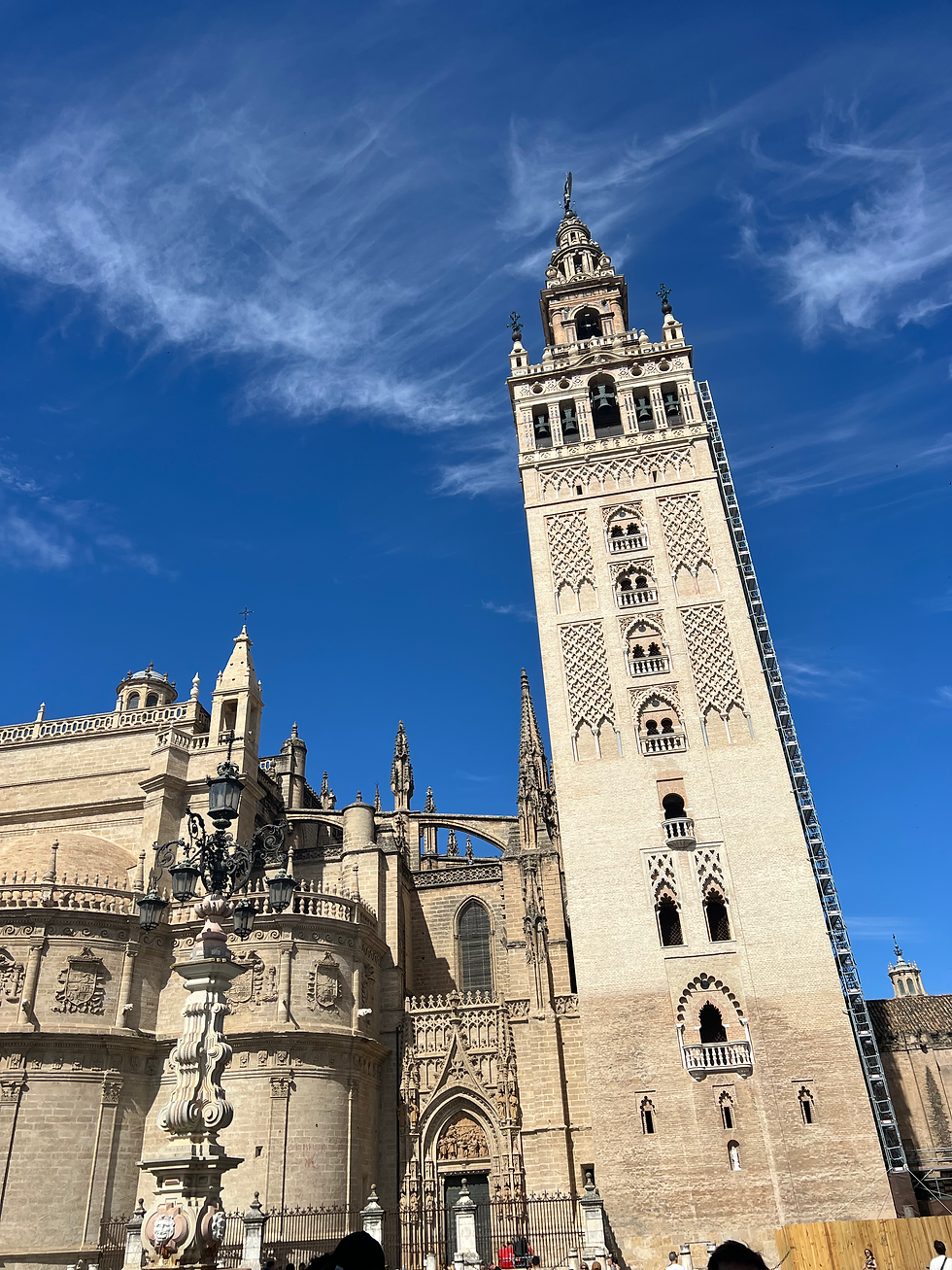
The largest Gothic cathedral in the world was built on the site of the city's former main mosque between 1401 and 1528. The Giralda, a 104-meter bell tower that began as the mosque's minaret before being converted into a Christian bell tower and topped with a Renaissance addition, gives panoramic views over the entire city if you climb it. The tomb of Christopher Columbus is inside the cathedral as well. Book tickets in advance at catedraldesevilla.es or you can attend a mass service and after you will have access to see the floor-to-ceiling gold-plated altar, massive organs, and Columbus's tomb.
Seville Cathedral in Southern Spain Golden alter in Seville Cathedral in Southern Spain Seville Cathedral in Southern Spain Seville Cathedral in Southern Spain Christopher Columbus' tomb in the Seville Cathedral in Southern Spain
Barrio Santa Cruz
The former Jewish quarter sits immediately next to the Alcázar, and it is a labyrinth of narrow whitewashed lanes, flower draped courtyards, orange trees, and small plazas. It is just as beautiful in the morning as it is in the evening, when the streets cool down and the restaurants set up their outdoor tables. Wandering around this neighborhood is a must and there will be many times that you find yourself back in Barrio Santa Cruz. You will also pass through Barrio Santa Cruz on walking tours, book this Guided Small-Group Walking Tour for a highly rated and affordable guided tour of Sevilla.
Flamenco
Sevilla is the home of flamenco, and watching an authentic performance here is a completely different experience from seeing it anywhere else. La Carbonería in Santa Cruz is the most famous free venue, a casual bar where spontaneous performances happen nightly with no reserved seating, you just stand or sit at the bar like everyone else. Make sure to get there at least 30 minutes before the performance to get a seat, or an hour before if you want a good seat. If you want something more structured, Casa de la Memoria and Casa del Flamenco both offer small venue tablao performances with reserved seating and excellent standards. Museo del Baile Flamenco displays the varying styles of Flamenco and you can book your tickets here.
Day 2: Plaza de España, Parque María Luisa, Metropol Parasol, Rooftop Bars
Day two moves away from the old town center and into Sevilla's more open, green, and modern side, before ending high above the rooftops.
Plaza de España
This is one of the most spectacular public squares in Spain. It was built in 1929 for the Ibero-American Exposition, and the enormous semicircular plaza features a central fountain, a canal with rowing boats, and a series of tiled alcoves representing each province of Spain. Go early in the morning for the best light and almost no crowds, this place gets busy fast once tour groups arrive.
There are also free flamenco performances at the center of Plaza de España, so if you don't catch flamenco night one, you will be able to see it here. If you're looking for a fun way to experience Plaza de España, you can rent a rowboat and paddle through the canal that surrounds the plaza. Boat rentals last about 35 minutes and fit up to four people, making it a great activity for couples, families, or friends. Even if you don't rent a boat, it's fun to watch them from the bridges while taking in one of Sevilla's most iconic views. And the Real Alcazar is not the only filming location in the city, Plaza de España served as the royal city of Theed on the planet Naboo for Star Wars: Episode II – Attack of the Clones (2002).
Plaza de España in Sevilla, Spain Plaza de España in Sevilla, Spain Plaza de España in Sevilla, Spain
Parque María Luisa
Parque María Luisa, which wraps around Plaza de España, is a lush escape of fountains, shaded pathways, and manicured gardens, with peacocks roaming freely among the trees. The park also houses two excellent museums: the Archaeological Museum and the Museum of Popular Arts and Traditions, making it well worth lingering in for a relaxed late morning. Find a bench under the bougainvillea flowers, near a pond with baby ducklings swimming about, and take a moment to soak up the joys of travel.
Parque María Luisa in Sevilla, Spain Parque María Luisa in Sevilla, Spain Parque María Luisa in Sevilla, Spain
Metropol Parasol (Las Setas)
This is the most controversial and most distinctive modern building in Sevilla, a vast undulating wooden mushroom-like structure rising above Plaza de la Encarnación in the old town. The top walkway, with entry around 5 euros, gives extraordinary views over the old town and is genuinely one of the best sunset spots in the city. There is also a Roman ruin museum built into the ground level below the structure.
Metropol Parasol (Las Setas) in Sevilla, Spain Metropol Parasol (Las Setas) in Sevilla, Spain Metropol Parasol (Las Setas) in Sevilla, Spain Metropol Parasol (Las Setas) in Sevilla, Spain
Rooftop Bars
Sevilla has excellent rooftop bar culture. The EME Catedral Hotel rooftop faces the Cathedral directly. Eme Icon Terraza, on the same building, gives you a straight on view of the Giralda. Hotel Domine Bilbao's rooftop on Calle Alemanes is another great option if the first two are full. Or, you could spend your evening on this highly rated Sevilla Tapas Crawl Tour where you try 10 sample dishes at 4 different venues. Any good finds from this tour you can revisit on your final day in the city!
Day 3: Triana, Torre del Oro, Córdoba Day Trip
Spend your last day either on the local side of the river or take the short trip out to one of the most extraordinary buildings in the world, depending on how much time you have left.
Triana
Cross the Isabel II Bridge into Triana on the west bank of the Guadalquivir, and you will find the most authentically local part of Sevilla, the traditional neighborhood of bullfighters, flamenco artists, and ceramicists. The Mercado de Triana is an excellent covered market for lunch, and the ceramic tile shops along Calle Alfarero are the best place to buy traditional Sevilla azulejo tiles as a souvenir. Walk back across the bridge at sunset for one of the best views of the city.

Torre del Oro

This 13th-century octagonal tower on the riverbank was built by the Moors as part of the city wall system. The small naval museum inside chronicles Sevilla's role as the staging port for the Americas expeditions, and entry runs around 3 euros. The tower at dusk, glowing golden against the Guadalquivir, makes for one of the best photographs you will take in Sevilla.
Córdoba Day Trip
Córdoba is just 45 minutes from Sevilla by AVE train, and it is home to the Mezquita, one of the most extraordinary buildings in the world. The Moorish Great Mosque was converted into a cathedral after the Reconquest by the simple, almost shocking method of building a cathedral nave directly through the middle of it. For more ideas on what to do in Córdoba for a day, read my Córdoba travel guide here. Or, if you'd like to do a guided day trip where all the transportation and logistics are taken care of for you, check out this 3 Cities in One Day: Cordoba, White Village & Ronda from Sevilla tour where you are able to visit the nearby villages to see more of Andalasia without the hassle of making it an extra stop on your Spain journey.
Where to Stay in Sevilla
Best Area: Barrio Santa Cruz or El Arenal both put you within walking distance of the Alcázar, the Cathedral, and the city's best restaurants.

Budget: JOY Setas Coworking is one of the most celebrated hostels in Spain, with a rooftop pool, a genuinely social atmosphere, and an excellent location.
Mid-Range: Hotel Casa 1800 Sevilla in the Barrio Santa Cruz is beautiful, boutique, and centrally located, a solid pick if you want comfort without the splurge price tag.
Luxury: Hotel Alfonso XIII near Plaza de España is one of Spain's most celebrated grand hotels, a stunning Mudéjar palace originally built for King Alfonso XIII.
Practical Tips for Visiting Sevilla
Pace Yourself with the Heat: Sevilla gets genuinely hot for much of the year, and even in shoulder season the midday sun can be intense. Locals build their whole day around it, with a slower pace and a long lunch break in the early afternoon. Plan your sightseeing for morning and evening, save the hottest hours for a sit down lunch or a break back at your hotel, and always carry water with you.

Book the Big Sights Ahead of Time: The Real Alcázar and Sevilla Cathedral both sell out specific time slots, especially in spring and during Semana Santa or the Feria. Book both online before you arrive rather than risking a sold out day once you are there. Even 24 to 48 hours ahead is usually enough outside of peak season, but earlier is always safer.
Dress Respectfully for Religious Sites: The Cathedral and several smaller churches around the city expect shoulders and knees to be covered. A light scarf or shawl tucked in your bag is an easy fix that means you will not get turned away at the door if you did not plan your outfit around it.
Eat Late, Like the Locals Do: Dinner in Sevilla rarely starts before 9pm, and many kitchens do not open until then. If you show up somewhere at 7pm expecting a full dinner crowd, you may find the restaurant still setting up. Use that early evening window for a walk, a drink, or a tapa instead, and save your real dinner for later in the night like everyone else in the city.
Budget Realistically: Sevilla is more affordable than cities like Barcelona or Madrid, especially for food and drinks, but the major sights and guided tours can add up quickly. Tapas crawls are one of the best ways to eat well without spending much, since most tapas run just a few euros each.
For Vegans and Vegetarians: Traditional Andalusian food leans heavily on pork and seafood, so it takes a bit more searching to eat plant-based here compared to bigger cities. That said, Sevilla has a growing number of vegan friendly spots, especially around the Alameda de Hércules area, and most tapas bars can put together a vegetable based plate if you ask. I recommend looking up a few vegan friendly restaurants before you go so you are not scrambling once you land.
Frequently Asked Questions
How Many Days Do You Need in Sevilla? Three days is enough to see the major sights, including a day trip to Córdoba, without feeling rushed. If you want to slow down, skip the day trip, or add in extra time for tapas crawls and flamenco, four days gives you a more relaxed pace.
Is Sevilla Worth Visiting If I Have Already Been to Barcelona or Madrid? Yes, and honestly Sevilla feels like a completely different country from either of those cities. It has a slower pace, a deeper Moorish architectural influence, and a stronger flamenco and tapas culture than you will find further north. If you only have time for one Andalusian city, Sevilla is the one I would pick.
Is Sevilla Safe for Solo Female Travelers? Yes, I felt comfortable walking through Sevilla on my own, including in the evening around the old town and Barrio Santa Cruz. As with any city, stay aware in crowded tourist areas where pickpocketing can happen, and use the same common sense you would anywhere else in Europe.
Do I Need to Speak Spanish? It helps, but it is not required. Restaurants and shops in the main tourist areas are used to English speaking visitors, though learning a few basic phrases goes a long way, especially in smaller family run spots outside the most touristy streets.
What Should I Pack for Sevilla? Lightweight, breathable clothing is essential almost any time of year, along with comfortable walking shoes for the cobblestone streets. If you are visiting between June and September, sun protection is non-negotiable. A light scarf or cover up is worth packing if you plan on visiting the Cathedral or other religious sites.
Next Stop
Sevilla pairs naturally with the rest of Andalusia. If you have more time, Granada and its Alhambra are about three hours away by car or bus, and Málaga, with its beaches and the spectacular Caminito del Rey hike, is roughly two hours by train. Together, Sevilla, Granada, and Málaga make up one of the best regional itineraries in all of Spain, and each city brings something completely different to the trip. If you are building out a longer Spain itinerary, I would recommend starting in Madrid, making your way south through Sevilla and Granada, stopping in Córdoba, and finishing on the coast in Málaga before flying home.


Mình chơi xổ số chủ yếu để giải trí nên thường xem kết quả cho vui, không quá kỳ vọng chuyện trúng lớn. Hồi trước nghe mọi người nói về “cầu” này “cầu” kia mình cũng bán tín bán nghi, nhưng theo dõi lâu hơn thì thấy đôi khi có vài điểm lặp lại khiến mình để ý. Mỗi khi đọc mấy bài nhận định, mình hay ghi nhanh vài gạch đầu dòng rồi đối chiếu lại sau để xem mình có tự thuyết phục bản thân quá không. Dạo này thỉnh thoảng mình cũng liếc qua https://soicauxsmb.io/soi-cau-xsmb-mien-phi-ngay-hom-nay.html để có thêm chuyện tám. Có bữa trúng chút thì vui, nhưng cũng nhiều hôm lệch hẳn nên mình tự nhắc đừng…